Roof · moisture screening
The roof is wet months before the ceiling tile says so
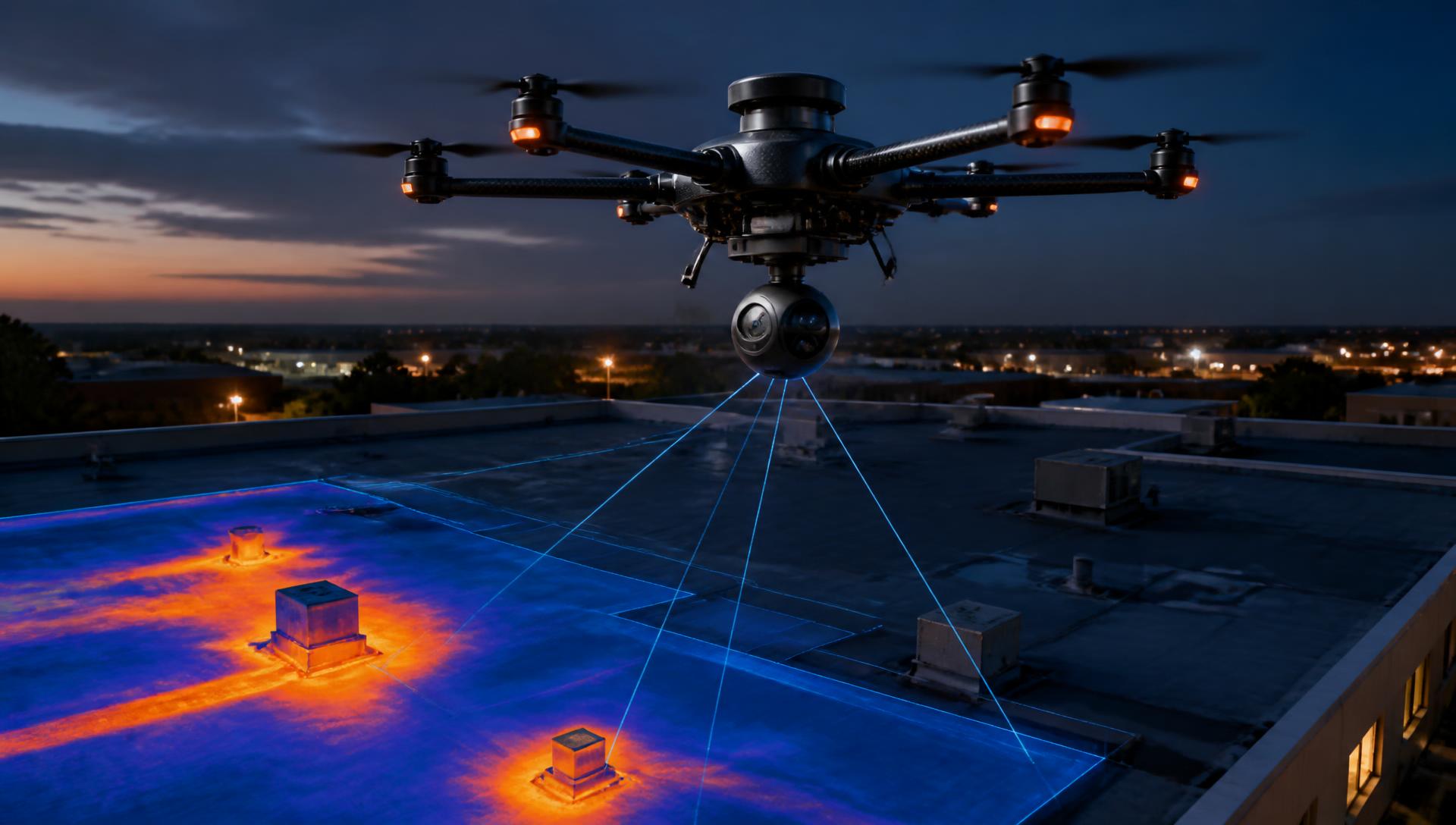
RGB plus radiometric thermal, flown as one job: seams, penetrations, ponding, flashing and impact damage annotated on an orthomosaic, and trapped moisture outlined and measured in square feet — a report an estimator, roofer or adjuster can act on the same day. $150–$400 residential · $750–$3,500 commercial.
The system
Fly the roof → thermal window → outline the wet → exception list
Daylight RGB pass
Full-roof mapping grid plus close-range detail on every penetration, drain and edge.
Thermal window
The radiometric pass is flown after sundown, when wet insulation gives back heat and dry does not — the ASTM C1153 condition.
Outline & quantify
Wet signatures are outlined on the orthomosaic and reported in square feet, so a cut test can be targeted instead of guessed.
Exception list
Findings pinned to bay, drain and penetration number and sent to management only.
Penetrations & flashing
Every boot, curb and lap measured without a person on the membrane
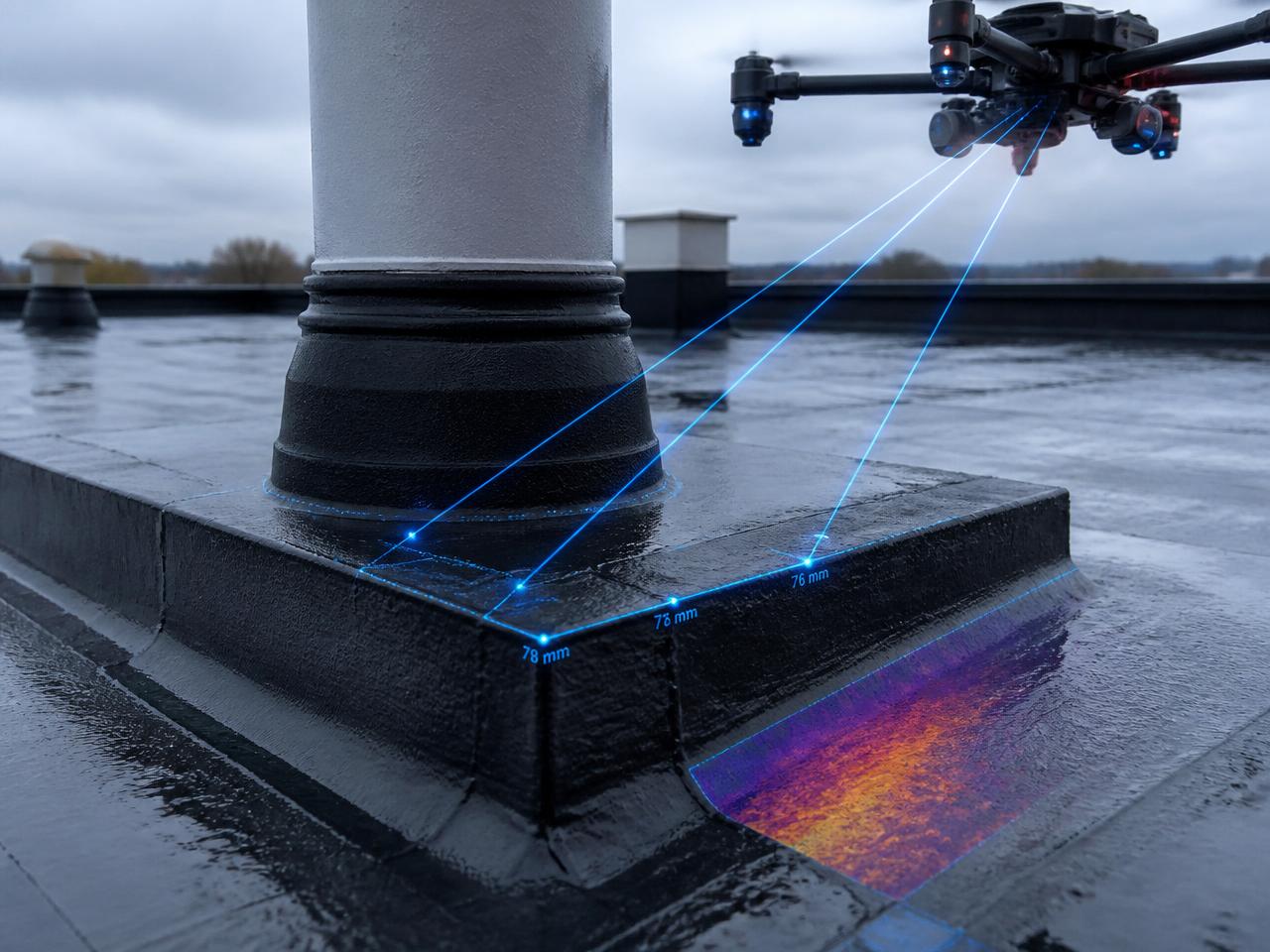
Most roof failures start at something that goes through the roof. The drone works penetration by penetration at fixed standoff: boot condition and clamping, curb flashing height and lap, termination bars, seam width along each run, and the sealant at every collar. Nobody walks the membrane in the heat, and nothing gets stepped on to be inspected.
- Seam lapsWidth measured along the run
- PenetrationsBoot, collar and clamp condition
- CurbsFlashing height and lap
- PondingFootprint and depth from the surface model
- MoistureWet area outlined in square feet
Cost of not catching it
Caught inside the warranty window, trapped moisture is a cut, a dry-out and a patch. Left alone it spreads through the insulation until the answer is a full membrane reconstruction — commonly cited above $150,000 for a single building. A flight costs a few hundred to a few thousand dollars.
Coverage
Every roof check, and the sensor that makes it
| Inspection | What is verified | Sensor |
|---|---|---|
| Membrane seams | Lap width, fishmouths, open seams and patch history | High-res RGB |
| Penetrations | Pipe boots, curbs, vents and stack flashings at close range | Macro RGB |
| Trapped moisture | Wet insulation and subsurface saturation, area quantified | Radiometric thermal |
| Ponding | Standing-water footprints and depth off the surface model | LiDAR volumetric |
| Slope to drain | Actual fall against the design slope, drain by drain | LiDAR |
| Drains & scuppers | Blockage, sump condition and clamping-ring seating | RGB |
| Edge & parapet | Coping joints, counterflashing, termination bars and fasteners | RGB + LiDAR |
| Impact & hail damage | Bruising, punctures and granule loss, mapped and counted | RGB + computer vision |
| Mechanical curbs | Curb flashing, gaskets and condensate staining around RTUs | RGB + thermal |
| Roof area & take-off | Measured square footage, perimeter and penetration count | Orthomosaic |
| Solar / equipment | Array standoff, ballast condition and hot cells | Thermal + RGB |
| Condition over time | Same flight path re-flown so change is measured, not remembered | Repeat capture |
Sample output
The roof exception list, by bay and penetration
| Location | Checked item | Spec | Drone measured | Status |
|---|---|---|---|---|
| Bay 3 · NE | Thermal moisture | Dry assembly | 1,850 sq ft wet signature | Fix now |
| Pen. 14 | Pipe boot seal | Sealed, clamped | Split boot, open at collar | Fix now |
| Seam 22-24 | Lap width | 3" min | 1½" over an 18 ft run | Fix now |
| Drain D-2 | Slope to drain | ¼" per ft | Ponding, 0.4 in depth | Review |
| Parapet · W | Coping joint | Sealed, backed | Two open joints | Review |
| Curb RTU-5 | Curb flashing | Lapped, fastened | Confirmed to spec | Pass |
Illustrative report format. Thermal anomalies carry the radiometric image and the measured area, so the roofer knows exactly where to cut and test.
Access economics
What a single pass costs against the access it replaces
Facade / envelope pass
$4k – $12k drone vs $37k – $75k scaffolded
~$33k – $63k per facade inspection
Plus 90–100% surface coverage against the 10–15% a scaffold setup actually reaches.
Roof moisture screening
$150 – $3,500 to fly it
~$140k+ avoided when it catches something
Against a membrane reconstruction cited above $150,000 once trapped moisture spreads. This pays off on the subset of buildings with a real moisture problem — insurance-style expected value, not every project.
Confined space / hazardous access
One documented hull survey
~10,000 labor hours and ~$1,000,000 in scaffolding
A ceiling example rather than a typical one, but it shows the range when access is genuinely dangerous or expensive.
Sonar · ultrasonic ranging
Laser and LiDAR are the primary measurement layer, but they lose confidence on dark, wet, dusty or mirror-like surfaces and at very short standoff. Sonar fills that gap: ultrasonic pulses resolve the small stuff — millimetre-scale gaps, offsets, thin clearances and shallow voids — in low light, through airborne dust and against surfaces a laser skips off. On this page it is what confirms standing-water depth in a ponding area and gap behind a lifted termination bar, at close range on a wet, glossy membrane where optical sensors wash out.
What you’ll receive
Roof, moisture & drainage — orthomosaic (GeoTIFF) of the full roof + PDF defect map with GPS-pinned penetrations, a thermal orthomosaic (GeoTIFF) with wet areas outlined and quantified, and a surface model (LAS) for ponding and slope — all measurable in your own software, no lock-in.
Open formats only: GeoTIFF · LAS/LAZ · E57 · OBJ/FBX · DWG/DXF · LandXML · PDF · CSV. No proprietary viewer required.
What it costs when nobody's watching
Roof work is where small water becomes a six-figure line item.
$150–$3,500
to fly a roof — residential to large commercial — against the membrane reconstruction that follows undetected moisture.
Source: Aerially.ai / iScano roof cost guides, 2026 — vendor pricing, not a third-party audit
$150,000+
commonly cited cost of a full membrane reconstruction once trapped moisture spreads through the insulation.
Source: Aerially.ai roof cost guides — industry marketing figure, not an audited statistic
ASTM C1153
the standard practice our radiometric roof moisture sweeps are flown and read against.
Source: ASTM International
389
fatal falls in U.S. construction in 2024 — 38% of all construction fatalities, and 95.9% of them falls to a lower level.
Source: BLS, Census of Fatal Occupational Injuries 2024 (released Feb 2026)
Government-grade sources (BLS, OSHA, NIST/NIBS) are cited as published. Industry research (Arcadis, FMI/Autodesk, CII, NSC) is survey- and estimate-based. Vendor case studies and vendor pricing pages are labeled where used and should be read as documented examples, not industry averages.